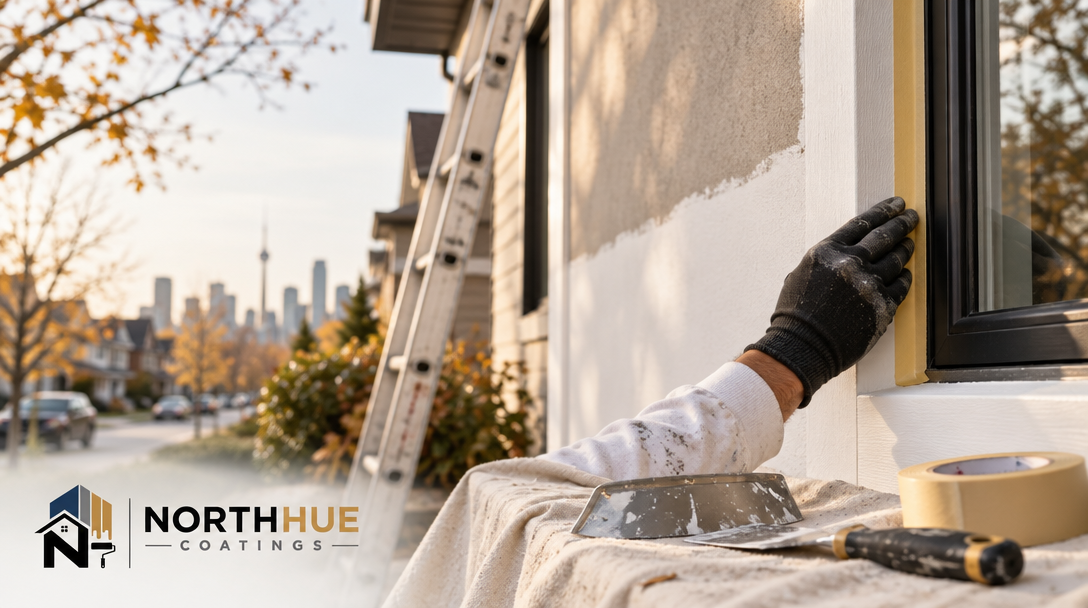
Quick answer: Most of the return on a paint project comes from what happens before the first coat goes on. Proper washing, scraping, sanding, patching and priming let a premium coating bond properly and stay bonded — which is what actually protects your siding, trim, stucco or drywall from moisture, UV and freeze-thaw damage. Skipping those steps is how homeowners end up repainting years earlier than they should.
Paint is the only part of your home that touches every other part of it. It sheds rain, blocks UV, slows moisture movement and holds the visual line between maintained and neglected. Yet on most projects, the coating itself is the inexpensive part. The real difference between a finish that lasts and one that fails early usually sits in the steps nobody photographs: washing, scraping, sanding, patching, priming and masking.
Why the cost of a paint job isn't in the paint
When homeowners compare quotes, they tend to compare the top number. It's more useful to compare what each number buys.
A low quote and a thorough quote often use similar products. What separates them is labor: how much time is spent preparing the surface, how many repairs are included, how carefully adjacent surfaces are protected, and whether the crew comes back to fix what the weather or the substrate reveals.
That's why two bids for the same house can differ dramatically — and why the cheaper one frequently isn't cheaper over ten years. If a coating fails in three to five years instead of eight to ten, you haven't saved money; you've bought the same project twice, with an extra round of disruption in between.
What professional surface preparation actually involves
Preparation isn't a single step. On a typical Toronto or GTA home — whether it's older brick and wood trim or newer fiber-cement and stucco — it breaks down into a sequence, and each stage exists for a reason.
Washing and degreasing
Exterior surfaces collect pollen, road film, exhaust residue and mildew. Coating over that film is like taping to a dusty wall: it looks fine on day one and releases later. A proper wash, followed by adequate dry time, gives the new coating a surface it can actually grip.
Interior walls need the same respect — kitchen grease, hand oils and soap residue interfere with adhesion in high-traffic rooms.
Scraping, sanding and feathered edges
Loose and flaking coating has to come off, and the transition between bare substrate and sound coating has to be sanded smooth and feathered. Skip this and the new coat telegraphs every ridge, blister and paint edge — a finish that looks older than it is, plus weak points where moisture gets a foothold.
Patching and substrate repair
Small cracks, nail pops, dents, soft wood, failed caulking and deteriorating window glazing are all opportunities to stop water before it spreads. Repairing them during prep costs a fraction of what the same damage costs once it reaches sheathing or framing.
Priming and sealing
Primer is not a cheaper version of paint. It's a different product with a different job: sealing porous substrates, blocking stains and tannins, bonding to bare or glossy surfaces, and giving the topcoat a uniform base so it cures evenly and holds color longer.
Bare wood, patched drywall, masonry, dark-to-light color changes and exterior trim all commonly call for a specific primer. Choosing the wrong one — or skipping it — is one of the most common causes of premature failure.
Masking, protection and cleanup
Detailed masking protects windows, hardware, flooring and landscaping, and it makes for clean, straight lines. A crew that treats protection as an afterthought tends to leave overspray, cut-in wobble and touch-ups you'll notice for years. Clean workmanship is part of the finish, not a courtesy.
What paint failure looks like when preparation is skipped
Failure rarely announces itself. It starts as something small and gets expensive:
- Peeling and blistering where moisture escaped or adhesion never formed.
- Chalking and fading on surfaces that absorbed the topcoat unevenly.
- Hairline cracks that widen season after season as water freezes and expands inside them.
- Mildew returning on a surface that was coated before it was fully clean and dry.
- Rust bleed and tannin staining on trim that needed a stain-blocking primer.
Each of these shortens the repaint cycle. A finish that should have given you close to a decade can need attention in half that time — and the repair work grows with every season it's deferred.
How premium coatings change the math
Premium exterior coatings generally carry more solids, better UV-blocking pigments and more flexible binders. In plain terms: they cover more thoroughly, hold their color longer and move with the substrate instead of cracking when the house expands and contracts through a Toronto winter.
Premium products also tend to stay cleaner and resist mildew better, which matters on north-facing walls and shaded areas that never fully dry. That means less washing, fewer spot repairs and a longer interval before the next project.
But premium coating is only as good as the surface under it. A high-end product applied over a poorly prepared wall will fail about as fast as an inexpensive one — and it will cost more to fix because removing it is additional work. The pairing is what creates the return: correct preparation, then a coating matched to the substrate, exposure and use of the space.
The structural case: coatings as protection, not decoration
Paint is your home's first line of defense, and it works on the same principle as a roof: it keeps water out and lets materials dry.
- Siding and trim stay protected from moisture cycling. Caulked, primed and coated joints keep driven rain out of seams that would otherwise wick water inward.
- Wood is sealed against rot and insect pressure. Bare or checked wood absorbs water, softens and loses its structural strength.
- Masonry and stucco get a breathable barrier that resists freeze-thaw spalling — the flaking and crumbling that happens when trapped water expands inside the wall.
- Interior drywall and plaster are shielded from humidity and condensation, which is where mold problems usually begin.
- Metal elements such as railings and flashing are protected from corrosion that quietly weakens fasteners and connections.
The pattern is consistent: water gets in through small breaches, and small breaches become structural repairs. Coating maintenance is inexpensive compared with what water does once it's behind the surface.
The resale side of the return
A well-prepped, well-coated exterior and a clean, evenly finished interior both read as "this home has been maintained." Buyers and inspectors interpret flaking paint, stained ceilings and cracked caulking as evidence of bigger problems, whether or not those problems exist. Fresh, properly executed paint doesn't just look better — it changes how the rest of the house is judged.
Questions to ask any painting contractor
The answers tell you more than the price does:
- What's included in preparation — washing, scraping, sanding, patching and priming?
- Which primer will you use on each surface, and why that one?
- What coating system are you recommending for this substrate and exposure?
- How are you handling existing moisture, rot or failed caulking?
- Are you licensed and insured, and who is on site each day?
- What does your workmanship warranty cover, and for how long?
- How will you protect windows, floors, landscaping and furniture?
How NorthHue approaches it
NorthHue Coatings provides detailed interior and exterior painting for homes and businesses across Toronto and the GTA. The work is built around careful preparation and clean workmanship, with a licensed and insured crew, clear communication and a tidy site at the end of every day.
We're rated 5.0 across 61+ Google reviews, respond to inquiries within 24 hours, and offer free, no-obligation estimates — including a straight assessment of what your surfaces actually need, and what can wait.
FAQ
Is premium paint worth the extra cost?
Usually, yes — if the surface is prepped properly and the product matches the substrate and exposure. Premium coatings typically last longer and hold color and adhesion better, which spreads their cost over more years. On low-exposure interior surfaces, a good mid-range product with excellent preparation can be the smarter spend.
How often should a home exterior be repainted in Toronto?
It depends on the substrate and how much sun and weather each elevation takes. Wood trim and siding usually need attention sooner than brick or fiber-cement, and south- and west-facing walls age fastest. A properly prepared, premium-coated exterior generally holds up noticeably longer than a quick recoat, which is why the prep budget pays for itself in the repaint interval.
Can I just paint over peeling areas?
No. Painting over loose or blistered coating traps the failure underneath and adds weight that pulls the new film off with it. Peeling areas need to be scraped back to sound material, feathered, primed and then coated.
Does exterior painting protect structural integrity?
It's one of the most cost-effective things you can do for it. Coating keeps bulk water out of siding, trim and masonry joints, limits freeze-thaw damage and slows rot. Left unmaintained, those small failures are what escalate into sheathing, framing and repair work.
Do I need to be home during the project?
For most interior work, no — crews typically need access to the rooms being painted and somewhere to stage equipment. Exterior work is largely self-contained. Either way, a clear scope, a schedule and a single point of contact make the week predictable.
The bottom line
Surface preparation and premium coatings aren't upgrades you add to a paint job. Together they are the paint job — the part that decides whether you're protecting your home for the next decade or paying for the same work again in a few years.
If you're planning interior or exterior work in Toronto or the GTA, start with a free estimate. We'll walk the surfaces with you, explain what preparation your home needs, and quote the coating system that fits — no obligation, with a response within 24 hours.